Thirty-Five Miles for a dB: Choosing Headphones for Mastering
AT A GLANCE
I have included a brief summary ahead of what is surely the most comprehensive resource I have ever attempted to compile.
-
Headphones can carry most mastering decisions. The hardest to hand over concern the bottom octaves: the weight of the low end against everything else and the shape of any short impulses down there. The lowest octaves are also where a master most often requires intervention.
-
A revealing low-end test is a kick drum over a sustained bass line. The kick should stand apart from the bass as much as it does in a well-treated room and then clear out. Low-frequency extension alone will not tell you whether a headphone passes that test.
-
Seal comes first and correction second. Glasses and worn-out pads color bass response. A published EQ preset is a starting point for correction, and personal adjustments in the higher octaves can bring it closer to a trusted reference point. Monitor at a fixed recallable level.
-
Choose the headphones based on things EQ can’t supply: a stable seal, comfort over long sessions, steady behavior as level rises, and bass errors broad enough that a fixture-derived preset still suits your head. Then use EQ for your anatomy and taste.
-
Crossfeed surrenders a headphone-specific advantage. Because headphones exaggerate low-frequency material in the sides, it’s easy to identify oddities down there. I keep crossfeed off in my primary reference.
-
With EQ, any of the headphones I auditioned might get close to the room. After all, I only listened to high-end headphones. For a portable reference I’m keeping the Audeze LCD-X because its seal barely reacts to my glasses. If you have speakers in a room you trust, learn how your headphones relate to that system.
Thirty-Five Miles for a dB
The studio is just over seventeen miles from my front door. Most days, it’s a pleasant enough drive. On others, it’s a thirty-five-mile round trip to make a 1 dB bass move on a revision that takes all of five minutes.
The room is worth it, of course. It is acoustically treated, digitally corrected and designed around a loudspeaker system that reproduces the lowest octaves of music without compromise. Unfortunately, the room can’t follow me home to my shoebox apartment in Leucadia.
So this quest began with one question: how do I take a mastering studio on the road?
The question is not mine alone. Mix engineers and producers regularly ask me how to get more out of a compromised listening environment, typically a spare room in an apartment or house. The conversation invariably arrives at the same constraint: budget. Square footage is expensive. A room with enough space for effective low-frequency treatment costs more still. Add correction and loudspeakers capable of the bottom octave and the undertaking lands firmly in five figures. Once serious treatment is off the table, the next question arrives right on cue:
Which headphones?
That question is harder than it sounds because the answer depends on what you need the headphones to do. This piece is my attempt to answer it for critical listening:
what headphones can and cannot replace
what to listen for in the bottom octaves
why headphones might differ there
and how to set up a pair you can actually trust.
Along the way I visited Dan Clark Audio here in San Diego and Audeze in Santa Ana, fully expecting to come home with a new piece of kit.
I came home with the headphones I already owned: the Audeze LCD-X. The “why” is far more useful than the conclusion alone.
On What Headphones Can (and Cannot) Replace
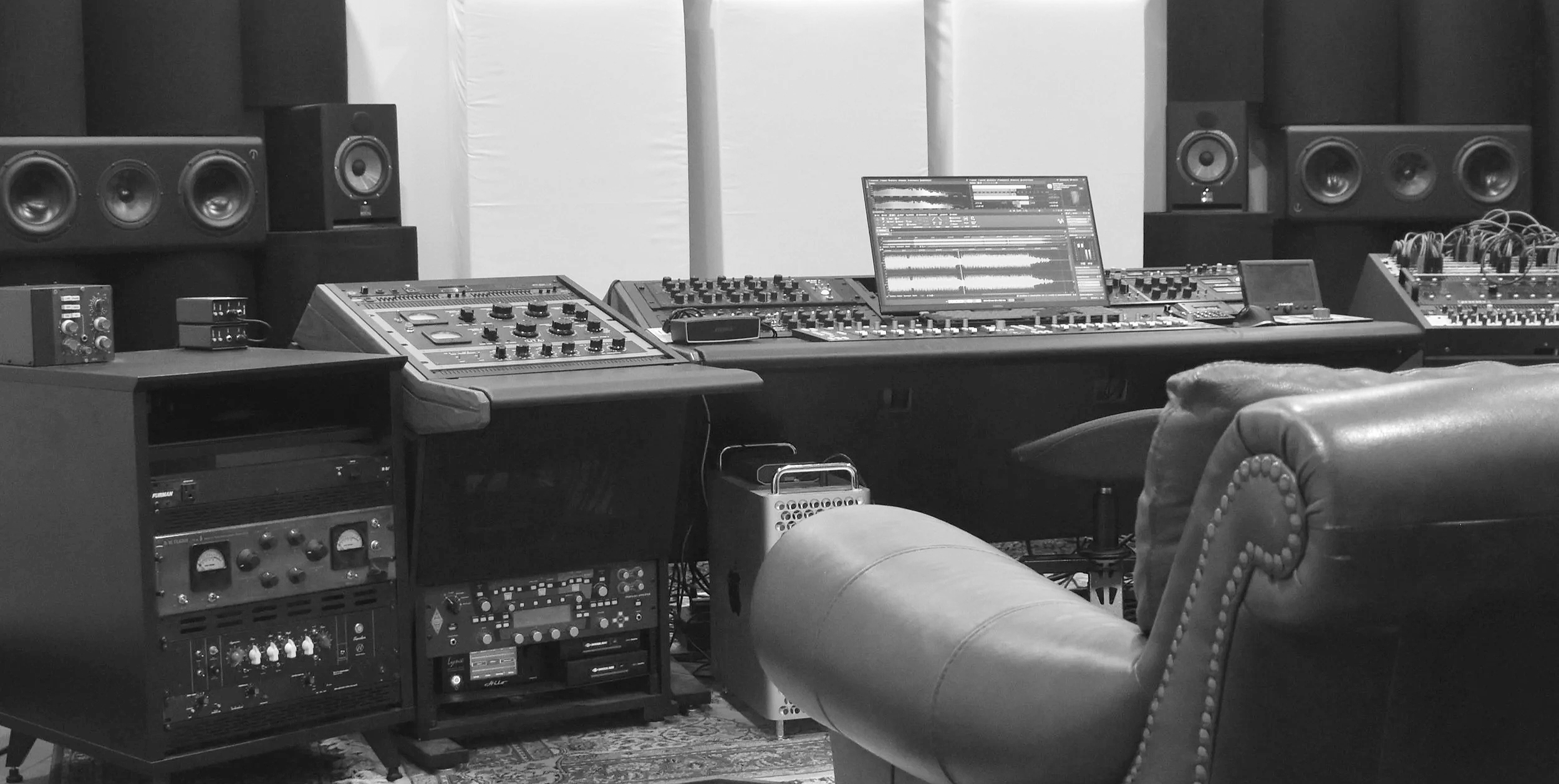
The Standard: Every headphone in this piece is weighed against my 400 ft² San Diego mastering suite, built around Ex Machina Quasar Mk IIs in an ASC Attack Wall. Deep porous absorption, active bass traps, Trinnov optimization… and gear that can’t travel.
It helps to be precise about what a good room provides. Some of its gifts are spatial: a phantom center suspended between two loudspeakers and an image that sits in front of the listener rather than inside the listener’s cranium. At a healthy level, the bottom octaves are felt in the body as well as heard in the ears. A good room’s supreme offering is bass that behaves. In a room of ordinary size, low-frequency waves form modes that swell some notes, swallow others, ring after a note ends and shift whenever the listener moves their head. Controlling these standing waves with acoustic treatment takes depth, floor space and a real budget.
Headphones sidestep the problem entirely. At low frequencies there is simply no room inside a headphone for modes to form. A good pair sounds essentially the same in a guest bedroom as in a world-class reference room. Headphones are also microscopes of near-infinite utility for edits, fades, noise floors, reverb tails and the crimes of lossy encoding.
Stereo imaging is another strength, with one caveat. On loudspeakers each ear hears both speakers, so what you dial in on headphones is not exactly what a listener hears in a room. You have to learn the relationship between your headphones and your speakers. That said, an image balanced entirely on headphones is not necessarily a bad one. A massive number of listeners now hear music primarily on headphones and many others are sadly subjected to systems that barely preserve a stereo image at all. Many single-box Bluetooth speakers sum to near-mono and a car seats a driver far closer to one speaker than the other. For those systems the most informative test of translation is a mono fold-down, which can be performed on headphones or loudspeakers.
The upper mids and treble can also be dialed in on headphones with confidence if three conditions are met:
the listening level is at a fixed reference
the headphones are corrected for your own taste and anatomy
the result has been checked against speakers (or masters) you trust.
All three are covered below.
What remains is the bottom of the spectrum. In my experience two decisions have typically demanded loudspeakers. The first is the relative size of the low end as a whole compared to the midrange and treble. The second is the low-frequency microdynamic profile: how high short impulses in the low end rise, how long they hang out near the top and how quickly they decay.
Together these decisions determine much of whether a master translates as intended across listening systems. Get them wrong and a master comes across as muddy or thin. Most often, it just doesn’t sound loud enough, and total level is only one factor. The other is shape. Peaks set the ceiling, but the ear judges loudness largely by how much of the signal sits near it and for how long. A low end with insufficient energy near its peaks and too much in the middle reaches the ceiling without actually sounding loud.
A kick over a sustained bass line is the most obvious example. When the kick’s burst is too low or too brief and its decay runs too loud for too long, the low end exists primarily in the middle. Many rooms can’t reveal that. Their modes ring much longer than the kick, blunting its rise and stretching its tail, so you hear the room’s imposed envelope in place of the mix’s. My treated room has been far better at revealing both the size and the shape of the bass.
That is what this quest was about: finding a headphone that can be trusted with those two decisions. For me, the LCD-X comes closest. Can I now work on headphones exclusively? Not quite. What stands in the way is mostly more ear training. A room delivers the bottom octaves to the body as well as the ear and adds a short decay of its own. A headphone delivers pressure to the ear canal and nothing else. Without the cues the body supplies, learning to judge weight and impact from that pressure takes time. You have to learn, by ear alone, the relative size of low-frequency impulses, how quickly these events arrive, and how quickly they leave.
What will never travel is the analog chain. My prized Knif Soma, Eksa and Vari Mu II stay at RQ. (The Vari Mu II alone occupies four rack spaces and houses ten tubes. It is not a carry-on.) The only work I take on the road is in-the-box work.
On Listening to the Bottom Octaves
First, a distinction that resolves many headphone debates before they begin. Casual listening is music playing while someone does something else. Attentive listening is sitting down with a record for pleasure. Critical listening is listening in order to make judgments. A headphone that excels at the first two can be the wrong tool for the third. This piece concerns the third.
Before this search began, I had spent time with two well-regarded (and very expensive) dynamic-driver headphones of the sort you find in studios everywhere. Both were pleasant, but both shared two unpleasant habits: a limited reach below 40 Hz and a tendency, in dense material, to let the bass beneath a kick drum swallow the kick whole. In the studio a kick lands, rises clearly above the bass and gets out of the way. That quality turned out to be the one I was listening for.
Picture a kick over a sustained synth bass. Both live mainly in octaves 1 and 2, roughly 33 to 131 Hz. (I number octaves from the C’s: octave 0 runs from about 16 to 33 Hz, octave 1 up to 65 Hz and octave 2 up to 131 Hz.) For the duration of the kick’s impulse, roughly 100 milliseconds, the mix calls for the kick to be perceptibly louder than the bass. Then it calls for the kick to stop and return that range to the sustained bass without lingering.
Playback can fail in two directions. It can overstate: the bass blooms and the bloom outlasts the kick itself. Or it can obscure: the kick arrives at nearly the same apparent level as the bass and dissolves into the bed. Either way the contrast the mix engineer created is no longer the contrast you hear. That contrast is precisely what I am judging when I decide how much compression, expansion, limiting or equalization belongs in the low end of a master.
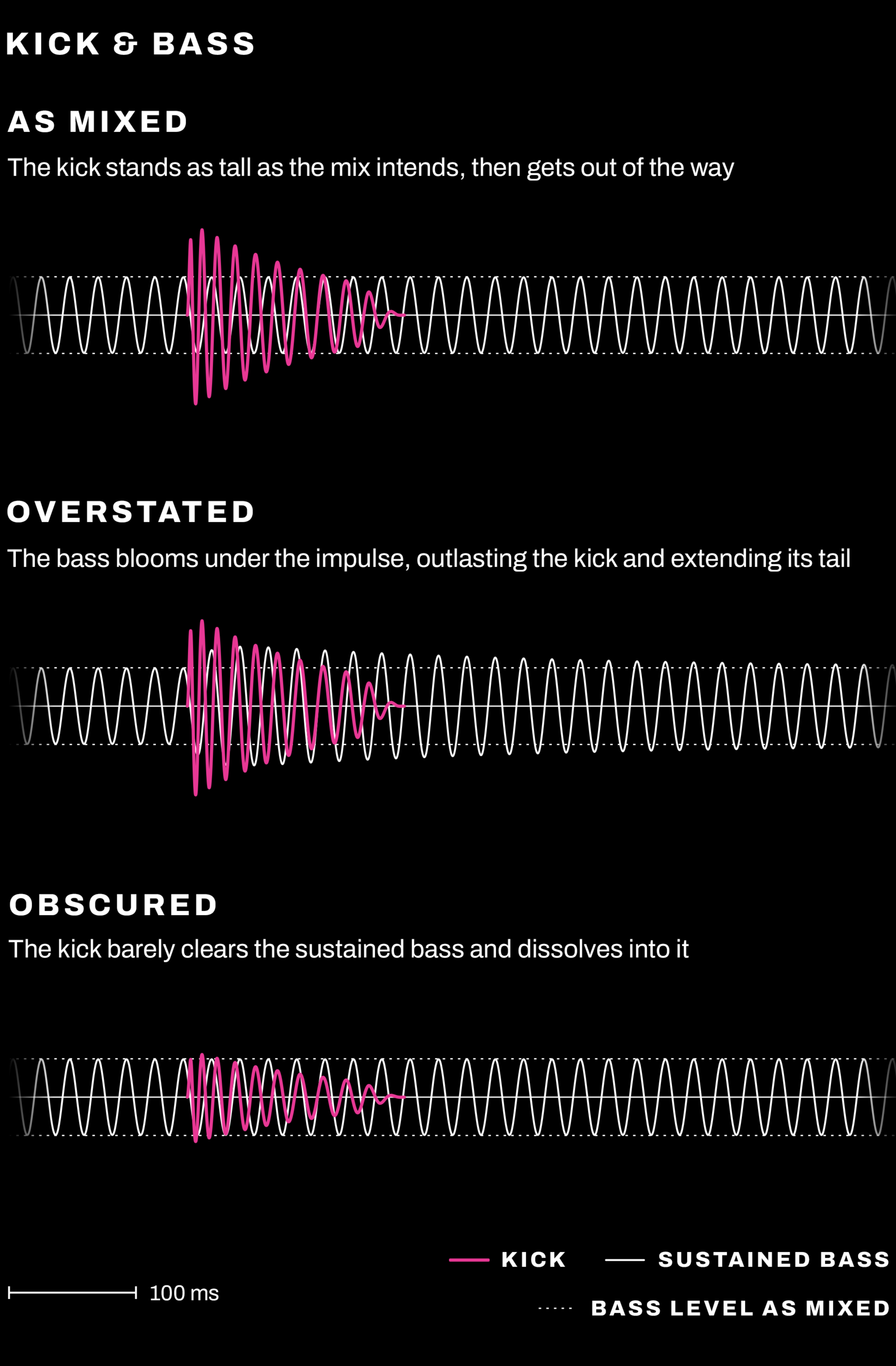
Two Kinds of Failure: The top row is the kick as mixed. Playback, on headphones or in a room, can turn it into either of the rows below.
The ear is unforgiving in this domain for two reasons.
First, the ear cannot separate low-frequency sounds by pitch as easily as it separates higher ones. Near 50 Hz a single auditory filter is at least 20–30 Hz wide. Below about 80 Hz, measurements suggest the filters vary widely from listener to listener, so a kick centered at 55 Hz and a bass note at 45 Hz compete within much of the same perceptual region. Down low, kick and bass are perceived as different instruments largely because their envelopes differ.
Dynamics are not a secondary quality of bass. The envelope is what allows a kick to be perceived as a kick.
Second, hearing is not instantaneous. The auditory system integrates sound over a window of tens to a few hundred milliseconds, which overlaps the duration of many kick transients. A short event needs more physical level than a sustained one to be perceived as equally loud. So the margin between kick and bass is often narrow and carried by only a few cycles: at 50 Hz a 100-millisecond kick contains about five cycles. A playback system that shifts the balance in this region by a decibel or two alters that event more than those small numbers suggest.
The test is therefore simple to state:
Does the kick stand apart from the bass by as much as it does in a well-treated room and clear out about as quickly?
On Headphone Bass
Why would one headphone pass that test and another fail it? My first assumption was driver type. The dynamic headphones had failed, so a planar-magnetic design with its large radiating area and low moving mass would surely pass. I knew better than to believe driver type alone determines bass behavior, but I still would have bet on the planars. A small bet, of course. As the factory visits showed, I would have lost it.
The real answer begins with how low frequencies behave inside a headphone. A headphone divides the air around its diaphragm into two volumes: the front volume, between the diaphragm and the eardrum, and the back volume behind it. “Open-back” and “closed-back” describe the back. The front volume is always bounded by the diaphragm on one side and by the earpads against the listener’s head on the other. At low frequencies that front volume is very small relative to a bass wavelength. It behaves less like open air and more like a sealed pressure chamber. The diaphragm isn’t launching a room-filling wave. It is compressing and releasing a small pocket of air.
That changes the situation considerably. A loudspeaker radiating into a large space needs roughly four times the diaphragm displacement to maintain the same level one octave lower. In a well-sealed headphone that penalty largely disappears: the same displacement produces about the same pressure at 20 Hz as at 200 Hz. The displacement itself is minuscule. For a large planar at a loud listening level, excursion works out to well under a micron.
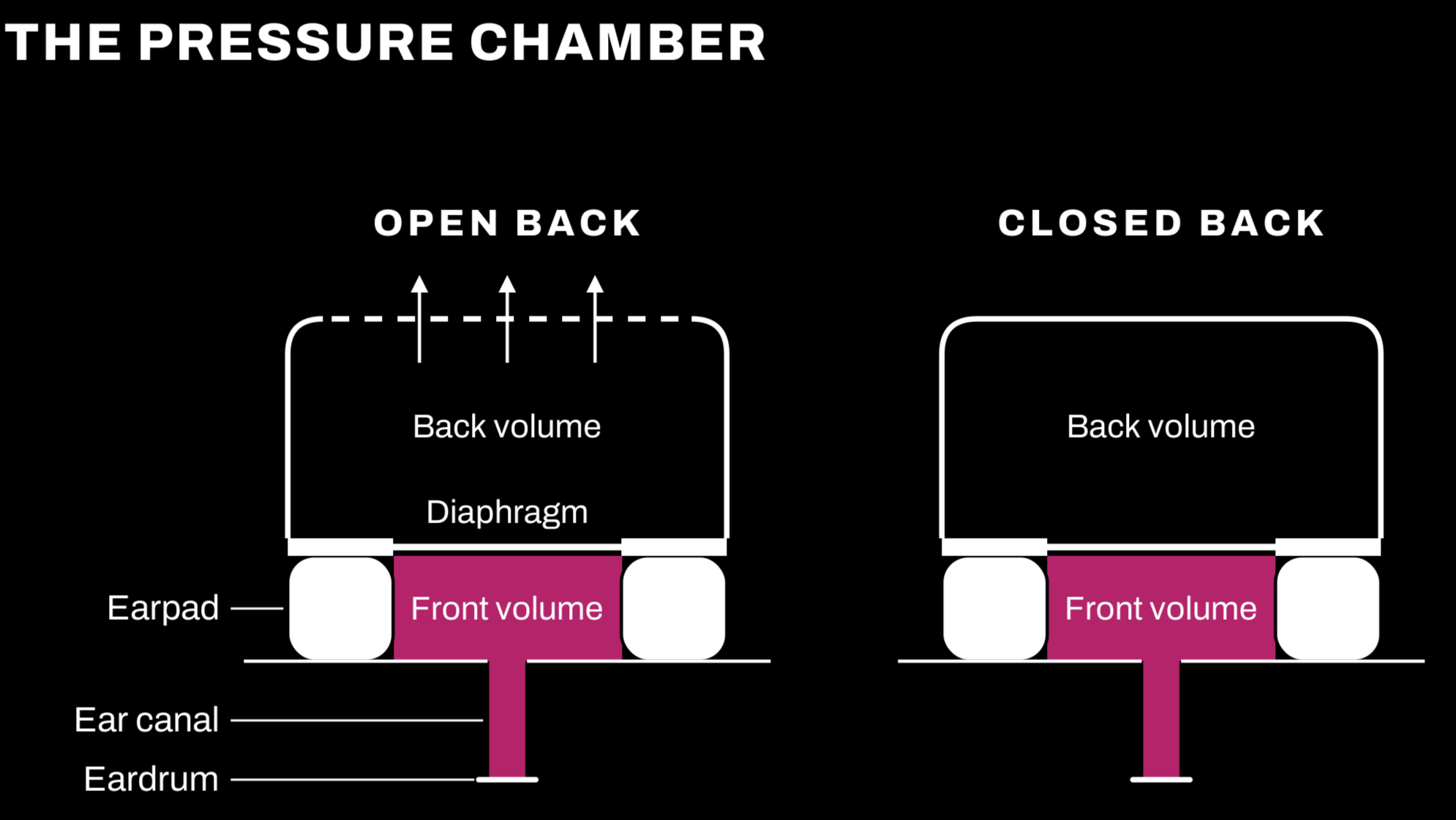
Open v. Closed: “Open” and “closed” describe the back volume of air, while earpads bound the front volume.
So deep bass is well within reach of a sealed headphone. That doesn’t mean every headphone delivers it. Leaks, vents, pads and tuning decide what actually reaches the eardrum, and the dynamic headphones I had used before plainly stopped short below 40 Hz. But extension alone doesn’t tell me whether I can judge a kick against a bass line. Two headphones can both reach 20 Hz and present that relationship very differently.
My next explanation for that difference was timing. Every mechanical and acoustic system has resonances: frequencies it favors much as a plucked string favors its fundamental. A resonance builds up more slowly than the event that excites it. Moreover, a resonance keeps ringing after the event itself ends. A sustained bass note lasts long enough to collect the full gain of a resonance while a kick has begun and ended before it fully develops. The bass bed swells, the kick blurs and a tail persists after the kick should have exited the soundstage. It is an appealing story that matches what I heard.
It is also, I now suspect, a room’s story more than a headphone’s. How long a resonance rings depends on how sharp it is. The modes of an untreated room are sharp: at 50 Hz they can ring for several hundred milliseconds, longer than the kick itself. The majority of headphone bass resonances are likely broad and well damped. A well-damped resonance at 50 Hz, say with a Q around 1, falls 20 dB in about 15 milliseconds. That’s a small fraction of a kick. For a headphone resonance to smear a 100-millisecond kick it would have to be sharp enough to show up as a narrow peak in measurements (and as one-note bass upon audition).
There was a second reason to doubt the timing story. When I pitched the timing explanation to a mentor, he informed me that with a good seal, a headphone’s bass behaves close to what engineers call minimum-phase: its timing is tied to its frequency response. Change one and you change the other. Correct the response with EQ and you largely correct the timing along with it.
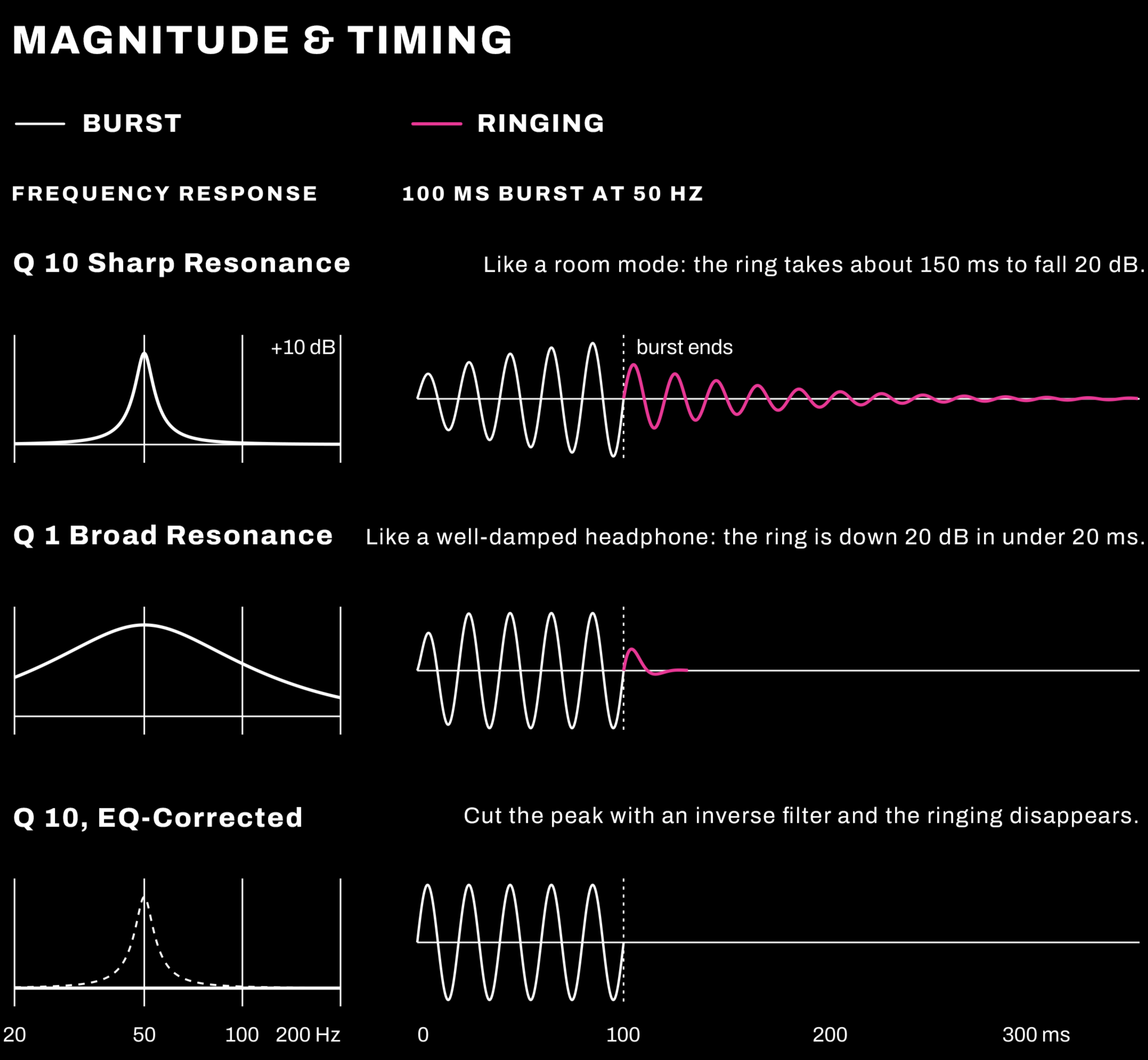
Illustrative Magnitude and Timing Model: Each row scaled to its own peak. Not a measurement. Minimum-phase filters, +10 dB at 50 Hz (and the inverse gain for the corrected example).
So when a headphone sounds “slow” to me, I now suspect I’m mostly hearing balance within the bottom octaves rather than the stored energy I first assumed. A headphone voiced with more level where a bass line’s fundamentals sit than where a kick’s punch lives will lift the bass bed without lifting the kick. That sounds slow even when nothing is ringing.
And the balance that reaches my eardrum isn’t necessarily the balance a measurement fixture reports.
Below 200 Hz is the territory in which seal and pad geometry matter most — those variables depend on the head the phones are sitting on. I’ll keep using “slow” and “fast” below as shorthand for what I heard rather than as a diagnosis.
Some behavior does sit outside any fixed frequency response. Consider a seal that shifts with glasses or jaw movement changing the response from one moment to the next. Or a driver that distorts or compresses as level rises, behaving differently at different levels. This is where driver type can matter. A large, light planar diaphragm coupled to a small front volume can deliver deep bass with very low distortion. But leaks, pads, cup acoustics and tuning all still apply, and which mechanism governs a particular headphone is a question for measurements. What you can do without measurements is listen for the result.
As for open versus closed, a closed back traps a second volume of air. That adds isolation along with more opportunities for enclosure resonances. I generally prefer open-back headphones for critical work in a quiet room. That is a preference rather than a rule; a well-executed closed-back design can be highly capable. The case study below includes one.
Two Factories: A Case Study
A word on method. Both visits were hosted by the manufacturers in September 2026. I received no loaners, discounts or compensation of any kind. Every comparison was made with the DAC/amplifier set flat and no EQ engaged. I matched levels approximately, to about 85 dBA on a phone SPL app, using the same passage of a song rather than calibrated pink noise. I can’t quantify the remaining level mismatch, so these are informal auditions rather than controlled comparisons. The two factories also used different chains, so I compare headphones within each visit with more confidence than across them.
Dan Clark Audio. Through a Luxsin amplifier I auditioned DCA’s flagship Stealth and Expanse along with the E3 and the ÆON CORE. All four were lightweight, compact and comfortable. In the midrange and treble the flagships did what excellent headphones do: they resolved detail, presented depth and made complex material easy to inspect without fatigue. From the upper bass up they also sounded remarkably close to my corrected reference, even in stock form.
The low end was another matter. At about 0:55 in Apparat’s “Hailin From the Edge,” two kick drums of distinct weight enter. On both flagships, the closed-back Stealth and the open-back Expanse, neither kick stood high enough above the tonal bass occupying the same octaves. That made it difficult to contrast their envelopes or judge how quickly either decayed. Removing my glasses changed the tonal balance but not that result, which suggests a leak at the temple wasn’t the cause. The ÆON CORE, a closed-back planar positioned as a more accessible entry point in the line, was the notable exception. It let the kicks through, though without the flagships’ excellent frequency response above, which could be addressed with EQ.
Initially I heard the flagships’ limitation as a timing problem, though I now suspect it’s really their bass tuning as it lands on my head. I didn’t audition them corrected, so I can’t say whether EQ would close the gap. Published fixture measurements suggest a broad correction might. What I can say is that uncorrected, some of the finest planars available shared a version of the problem I’d heard from the dynamic headphones.
Audeze. For the visit to Audeze I brought my own LCD-X. (Yes, I brought headphones to a headphone factory.) Through an RME ADI-2 DAC FS, I compared it to the factory’s brand-new LCD-X and two of Audeze’s newest models: the flagship LCD-5s and Manny Marroquin’s MM-520 collaboration. I also heard the LCD-5s and factory LCD-X through a dCS Bartók. The electrostatic CRBN2 played through the Bartók and a Mjölnir energizer.
The MM-520 is markedly lighter and easier to wear than the LCD-X. Its bass resembles the LCD-X’s but sounded lighter in the lowest octaves and a little slower in octaves 1 and 2. Its top end sits further back than I need for judging transients at higher SPL. Broad EQ would likely address both. Besides, a signature collaboration should be allowed to remain specific to the engineer who informed the design. The LCD-5s was the most enjoyable listening of the day: open and refined if a shade midrange-forward. Its bass still sounded a little slow in the lowest octaves for critical work.
The CRBN2’s low end was another story. It sounded like a pair of loudspeakers strapped to my head and could serve as a primary monitor. The bass was lifelike with none of the limitations above, though you still don’t feel sub bass in the body. At $5,995 before a sizable dedicated energizer and a converter worthy of both, the system that came closest to replacing loudspeakers in these auditions costs about what the loudspeakers do. It is certainly not suitable for travel.

Electrostatic Magic: In rooms where a loudspeaker system is impractical or impossible, the CRBN2 is worth consideration.
Of the headphones that fit in a bag, DCA’s ÆON CORE, my own LCD-X and the factory’s LCD-X were the only pairs doing what I was listening for, uncorrected, from octaves 0 to 3. The clearest moment came while I switched rapidly between the MM-520, LCD-X and LCD-5s on Strong Maurice’s “Rice Bowl,” which I mastered at RQ in 2021 before I owned planar headphones. On the LCD-X the bottom octaves came closest to what I hear in a well-treated room. The best description I have is that it sounds like speaker excursion: I hear and nearly feel the low end move forward and back. Given how little a headphone diaphragm travels, it is not literal excursion. I suspect it’s what deep extension sounds like when each of the lowest octaves sits in proportion to its neighbors. The other Audeze headphones invited me to think, “What gorgeous music.” The LCD-X invited inspection.
One more lesson came from comparing the two LCD-Xs. Next to the factory pair, mine gave up a little punch in octave 2. The drivers had not changed; the factory confirmed as much when I noted the difference. My pads had compressed. I can’t say whether that changed the seal, the front volume or both. But it’s worth noticing what I heard: a purely static change in the cushions registered to me as lost punch. Differences in frequency response can sound a lot like differences in speed.
On Seal, Glasses and Pads
Everything above depends on a seal: the least glamorous variable in the chain and as it turns out, one of the most consequential.
The pressure-chamber behavior persists only if the earpads keep the front volume closed. Open a small channel to the room and the air displaced by the diaphragm escapes instead of compressing in front of the eardrum. Bass falls away, and the leak can interact with the cavity in ways that vary with jaw movement, head position and pad placement. The bottom octave begins to move with the listener. That is precisely the room behavior headphones were supposed to escape.
Eyeglasses are a common culprit: temple arms can suspend an earpad slightly off the skin. I wear glasses. So do many of the engineers who ask me which headphones to buy. At both factories I took mine off and put them back on repeatedly with every pair. The DCA headphones gave up a little deep extension with glasses on and sounded slightly different each time I put them back on. Audeze’s MM-520 and LCD-5s were more sensitive still, while the LCD-X barely changed. Clamping force may be part of the explanation, though the relevant factors are almost certainly more complicated. A headphone that reacts strongly to glasses will also let its bass wander despite any correction curve.
Earpads are a slower version of the same problem. Foam compresses and seals loosen. The headphone I learned years ago is no longer exactly the headphone I own. Much like Le Grand K (the cylinder that defined the kilogram until 2019) a physical reference can drift, its betrayal revealed only by comparison. Pads belong on a replacement schedule just like the tubes in a vari-mu.
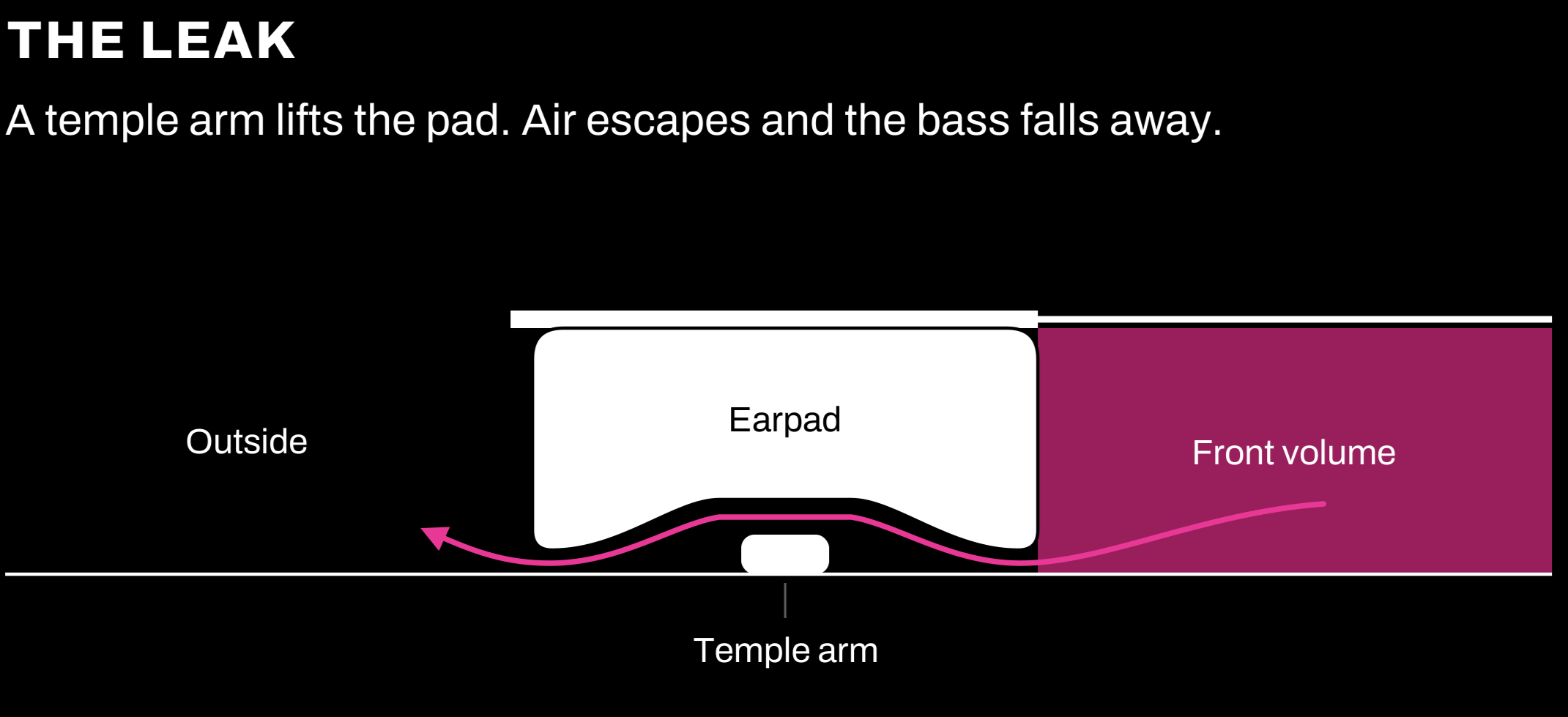
The Leak: If you wear glasses, try leather pads, thin temple arms or a dedicated pair of frames for headphone work.
On Correction and Level
Every comparison in the case study was made flat. At home I use correction, and in my view it is not optional. Every headphone departs from neutral in its own way and every listener’s ears depart from the average in theirs. Correction ought to address both.
The first part is straightforward. Measure a headphone on a test fixture, compare the result with a target curve and build an equalization curve that closes the gap. Harman’s target is a common choice. It began as an attempt to make headphones sound like good loudspeakers in a good room as measured at the fixture’s eardrum, and it was then refined through listener preference testing. Oratory1990 and others publish corrections to that target for hundreds of models.
The catch is the fixture’s ear. It is an average ear, which is to say it is nobody’s.
The ear canal is a short tube about an inch long, open at one end and closed by the eardrum at the other. Like any such tube, it resonates. With help from the outer ear, that resonance lifts the region around 3 kHz by more than 10 dB in a typical adult. It’s a large part of why human hearing is most sensitive there. (Some suspect the bias is an evolutionary advantage, since 2–5 kHz is where consonants carry speech intelligibility.) But canals vary. A longer canal resonates lower; a narrower or more curved one changes the height and shape of the peak. Differences of several decibels between listeners in the 2–5 kHz region are normal. Because hearing is so sensitive there, they are among the most audible differences in the spectrum.
With loudspeakers this is not a problem: the brain has spent a lifetime growing accustomed to its own ears. With headphones, the way a driver couples to one listener’s canal differs from the way it coupled to the fixture’s. A correction that is perfect on the fixture lands a little differently on every head.
Then there is taste. Even Harman’s own research found listeners split on how much bass and treble they prefer relative to the target. Around 3 kHz, preference and anatomy are difficult to tell apart. Some engineers want that region slightly forward so harshness has nowhere to hide; others pull it back to work for hours without fatigue.
My correction therefore has two layers. The first is population-level: the Harman-target preset oratory1990 publishes for the current LCD-X revision, loaded into the ADI-2’s built-in parametric EQ. It corrects the headphone. The second is personal: I pull the 4 kHz region down by 1 dB. It brings my headphones closer to what I hear in the room. Some of that is likely the difference between my ears and the fixture’s and some is probably taste.
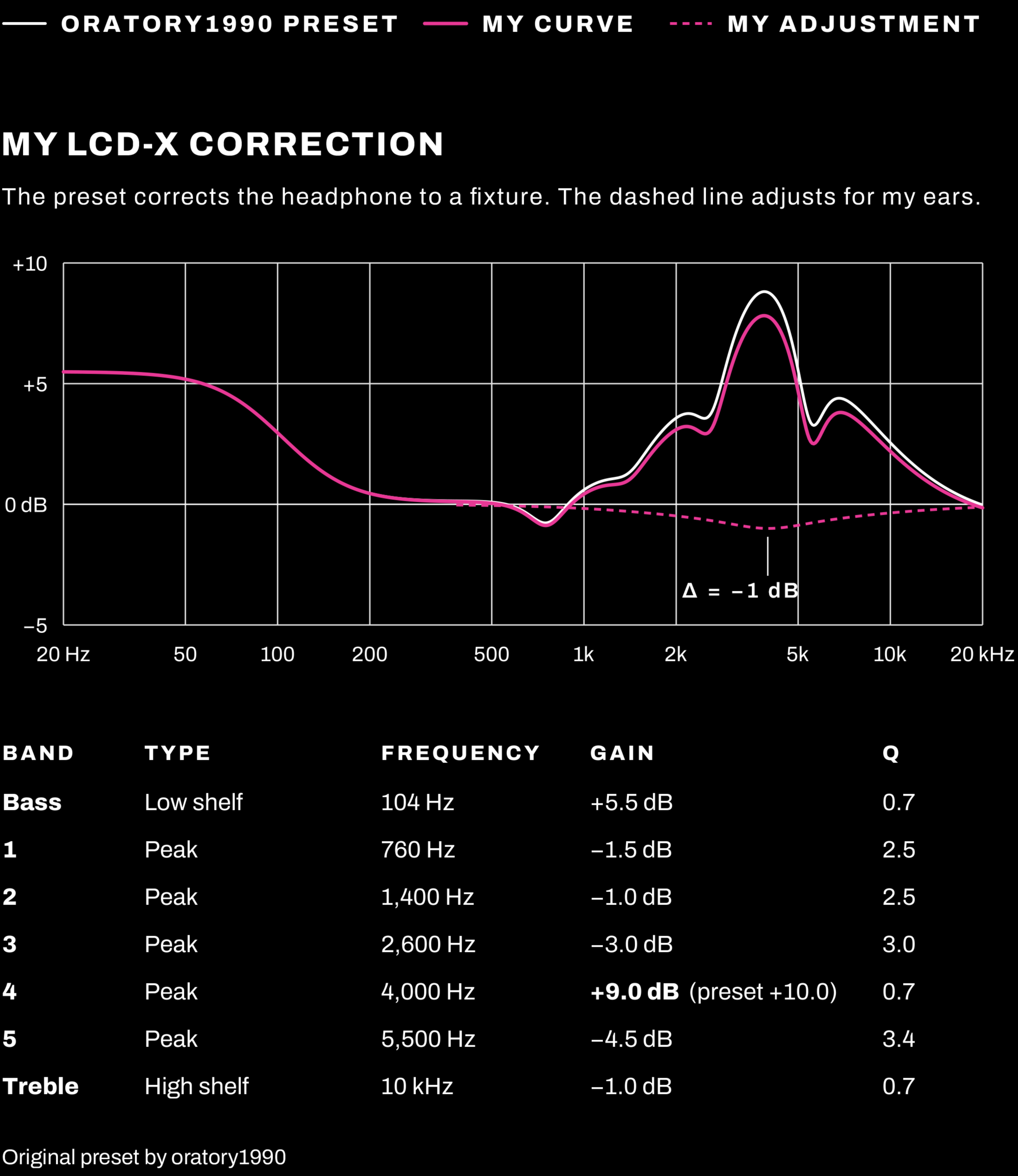
Two Layers: oratory1990’s Harman-target preset for the current LCD-X revision plus my own 1 dB cut around 4 kHz. Below 200 Hz, the correction is just one broad shelf.
That personal layer ought to be found by comparison rather than preference alone. Play familiar material on headphones and on the best loudspeakers in the best room available. Then make small, broad moves between roughly 2 and 10 kHz until vocals and cymbals sit where they sit in the room. Without a trusted room, a handful of commercial masters you know intimately can serve as a reasonable reference instead. Either way, keep the moves broad, particularly in the bass. A narrow boost down there is a new resonance and will ring like one. A narrow cut only cancels a resonance if it lands exactly on it — and below 200 Hz, a fixture-derived measurement can’t tell you where that is on your head.
Level matters just as much. The ear’s sensitivity to bass and treble shifts with loudness, so a balance judged at one level will not hold at another. I monitor at a fixed level stored as a recallable state on my DAC. On modern material it reads roughly 80–85 dBA on a handheld meter. A handheld meter can’t measure sound pressure at the eardrum, so the number matters less than its consistency: the same state for every session. With a fixed reference level and a correction fitted to my own ears by comparison with the room, I am comfortable dialing in the upper mids and treble on headphones.
Wherever correction occurs, it belongs in the monitoring path and never in the mastering chain.
Static EQ is very good at correcting behavior that stays put, including the timing of a well-behaved bass resonance along with its level. What it cannot correct is behavior that changes with fit or with level. On the LCD-X the kick’s rise came through my correction intact, which is what I’d expect. Below 200 Hz the whole correction is one broad shelf. It adds nothing that rings, and where kick and bass overlap it lifts them by nearly the same amount.
The order of operations follows naturally. Choose the headphone for what EQ cannot fix: a seal that stays put, comfort over a long session, steady behavior as level rises, and bass errors broad enough that a correction curve made from a fixture still fits your head. Then use EQ for what it can fix.
You can check that last quality before buying. If a headphone’s published preset leans on narrow filters below 200 Hz, I’d treat it as a warning: those are the corrections least likely to land in the right place on your head.
On Crossfeed
On loudspeakers, each ear hears both speakers. On headphones each ear hears only its own channel, which is a large part of why the image sits inside your head. Crossfeed attempts to correct this by feeding a filtered and slightly delayed portion of each channel into the opposite ear. Simple designs like the widely used BS2B algorithm low-pass the signal they feed across, so most of the blending happens below several hundred hertz.
At those frequencies, crossfeed is mostly imitating loudspeakers. The head barely shadows low frequencies, so on loudspeakers both ears receive the bass from both speakers at nearly the same level. Crossfeed makes headphones behave more like that. It’s fun, and for casual listening it often sounds better.
The reason I keep it off for mastering runs the other way. Without crossfeed, headphones exaggerate low-frequency side content. Wide or out-of-phase bass that’s easy to miss on loudspeakers is hard to miss on headphones. When I’m deciding whether a low end needs narrowing, for a cut to vinyl or for the near-mono systems described earlier, that exaggeration is useful. It’s the same microscope that makes headphones excellent for edits and fades.
So crossfeed stays off in my primary reference. If I were mixing, I might toggle a simple crossfeed on my DAC every now and then as an alternate view of how the image will translate. Newer approaches may change the calculus. Topping now offers a convolution-based crossfeed that models head-related transfer functions and room acoustics alongside a simpler BS2B mode. I have not auditioned it.
An Example Rig
If budget is the constraint, start with the headphones you already own. The method in this piece works on virtually any decent pair. What follows is my configuration, not a minimum.
My suspicion going in was that four figures spent carefully could get reasonably close to a room. Cans, conversion, current, cables and correction: here is my rig at today’s published prices.
Cans: Audeze LCD-X, $1,199 new plus $90 for a spare set of pads. Used pairs of the current revision often appear for $700–$900.
Conversion and current: RME ADI-2 DAC FS, $1,299. It has ample power for the LCD-X and many other demanding headphones; headroom needs depend on sensitivity, impedance, EQ boost and listening level. Its recallable states also hold the reference level and the correction curve. The alternative I’d happily recommend is Topping’s DX9 Discrete.
Cables: The cable in the box. A planar’s comparatively flat impedance means a few tenths of an ohm of cable resistance creates a tiny level change that’s essentially uniform across the audible band, roughly a tenth of a decibel on the LCD-X. I suspect barely perceptible level differences like that account for some perceived cable differences. Because I answered my question before getting to cables, that debate will have to wait.
Correction: Free with any digital parametric EQ or built into the RME.
That totals $2,588 new before tax. Comfortably four figures, rather than the five (or six) figures of the room or the CRBN2 system I heard.
Coming Home
For casual and attentive listening, the LCD-5s through the Bartók was the best system I heard at either factory. Of the other Audeze headphones I could carry, the MM-520 came closest to the LCD-X in the bass while remaining easier to wear. Both may be more rewarding to live with than the LCD-X, and both are plausible tools for serious work.
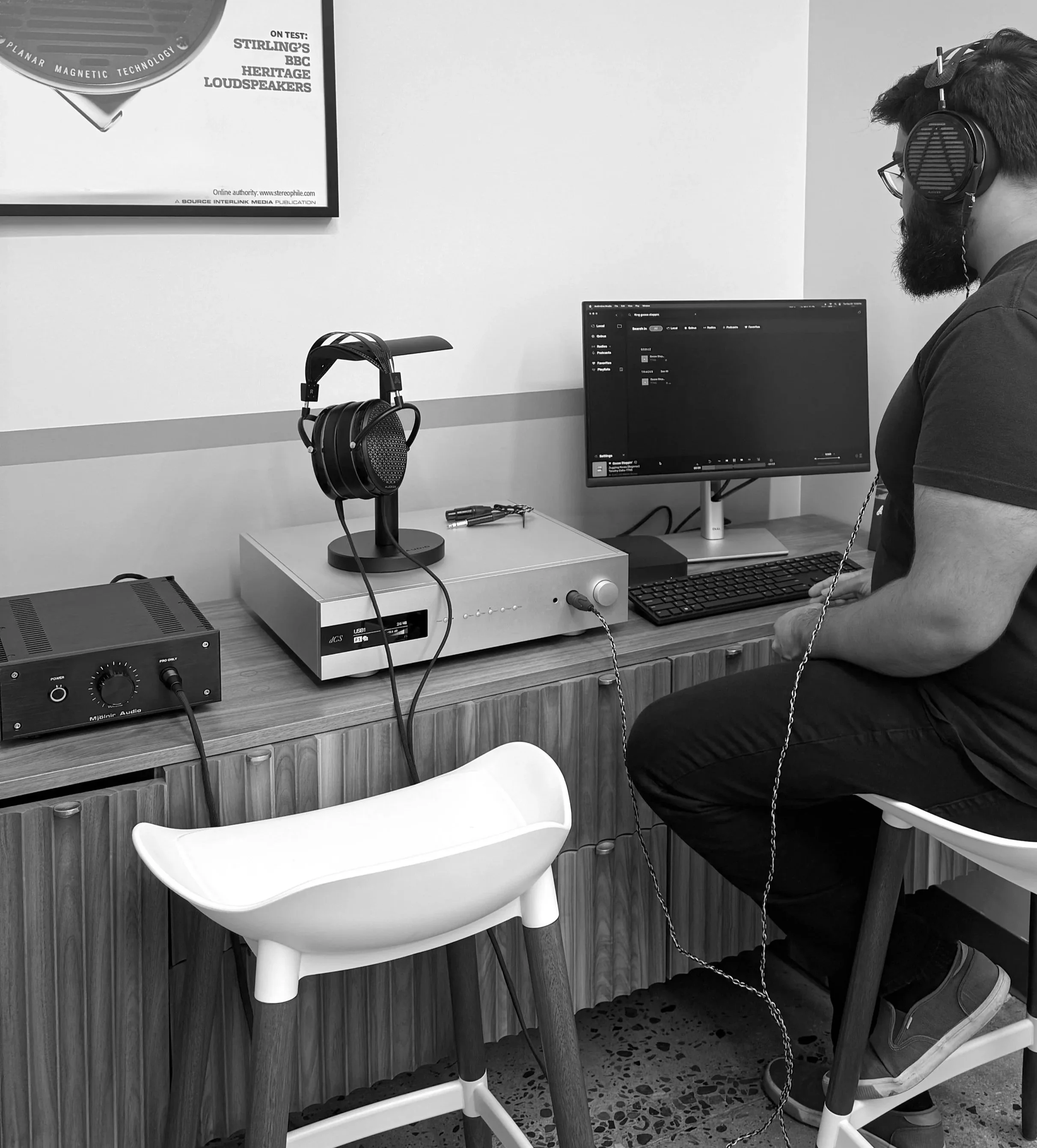
Five-Figure Playback: Listening on LCD-5s through the Bartók to TTNG’s “Goose Steppin’,” which I mastered at RQ in 2026. Quite the treat.
DCA’s ÆON CORE deserves a direct comparison against the LCD-X. At $899, it’s an especially compelling one. I’d like a corrected Stealth or Expanse in the lineup too, which would tell me whether the limitation I heard from the flagships yields to EQ. I’ll report back.
For critical listening in the bottom octaves, the LCD-X remains my selection. I went looking for something better and, short of the CRBN2, nothing I heard obviously cleared the bar. Uncorrected, it and the ÆON CORE were the only headphones I could carry whose low end behaved like a well-treated room’s to my ears. Both let the kick stand apart from the sustained bass and then clear out. But by my own reasoning, EQ might get any of the headphones I auditioned there too. What separated them for me came down to two things: how the lowest octaves sat relative to one another and how much the seal changed with my glasses. A broad correction can fix the first, but only if the second holds still. The LCD-X barely reacted to my glasses, perhaps because of its clamping force. No correction curve can supply that. The price is comfort: it is heavier than anything else I tried. If you don’t wear glasses, that trade may come out differently for you. In short, the headphone I went searching for was on my desk the entire time.
Total transparency: I have spent years with the LCD-X, and familiarity is powerful. Some part of why it sounds right to me is surely that I know it well. I would not say familiarity alone explains why one headphone lets a kick stand clear of a bass line while another does not. It helps that I mastered “Rice Bowl” in the room before I owned planar headphones, so on that track the LCD-X was matching the room rather than my habits. But I cannot rule out that bias, so I have stated it plainly.
For the engineers who ask me which headphones, the short answer is that the method matters more than the model. Listen for the kick in music you know well. Change one thing at a time, glasses or pads first then correction, and then compare against speakers. A difference worth acting on is one you can hear more than once. If you have speakers and a room you trust, learn how your headphones relate to them. If you don’t, a few masters you know intimately will be a reasonable stand-in.
The drive to and from the studio has partly become a choice. A headphone can provide an exceptionally useful critical reference. It can’t give you a good room’s spatial image or the bass you feel in your body. Most days I’ll still make the drive for the analog chain.
But when the work has to travel, I now know what I can trust and for which tasks.
What I Listened To
All listening was done through Tidal and Qobuz at their highest available resolution, with every chain set flat and levels approximately matched as described in the case study.
Chains
Dan Clark Audio: Luxsin headphone amplifier, set flat
Audeze, primary: RME ADI-2 DAC FS with DC protection engaged (ON, not FILTER) for the LCD-5s, MM-520, factory LCD-X and my LCD-X
Audeze, secondary: dCS Bartók for the LCD-5s and factory LCD-X; dCS Bartók with a Mjölnir electrostatic energizer for the CRBN2
Tracks
Apparat — “Arcadia (Album Version)”
Apparat — “Hailin From the Edge”
Shudder to Think — “X-French Tee Shirt”
Radiohead — “Everything in Its Right Place”
Botch — “Afghamistam”
Murkury — “Zenith”
Polyenso — “Falling in Rain”
Maps & Atlases — “4/25”
Radiohead — “Weird Fishes / Arpeggi”
Carla Bley — “Lawns”
Tinariwen — “Amoss Idjraw”
Toy Matinee — “Queen of Misery”
The The — “August & September”
The The — “August & September” (Remastered)
Nils Frahm — “Forever Changeless”
TTNG — “Goose Steppin’”
Strong Maurice — “Rice Bowl”
References & Acknowledgements
Behavioral estimates of human frequency selectivity at low frequencies (Jurado, PhD thesis)
What’s the definition of an “open” or “closed” headphone? (oratory1990)
Listener Preferences for In-Room Loudspeaker and Headphone Target Responses
Segmentation of Listeners Based on Their Preferred Headphone Sound Quality Profiles
Factors That Influence Listeners’ Preferred Bass and Treble Levels in Headphones
How can cables affect the sound of a headphone/loudspeaker? Is this important? (oratory1990)
I’d like to thank Brandon and the staff at Dan Clark Audio as well as Matt and the team at Audeze for hosting these auditions.
A massive thank you to oratory1990. I have learned a great deal about headphones, measurement and correction from his writing.
I’d also like to thank Isaac Asimov, whose writing instilled in me both rigor and the need to follow a line of reasoning through to a practical solution. To Dr. Asimov, I apologize for dropping the Oxford comma.
To the lovely Nat Calkins, thank you for your company, your photography and your editorial eye.