Let's Discuss the Knif Soma Mastering Equalizer
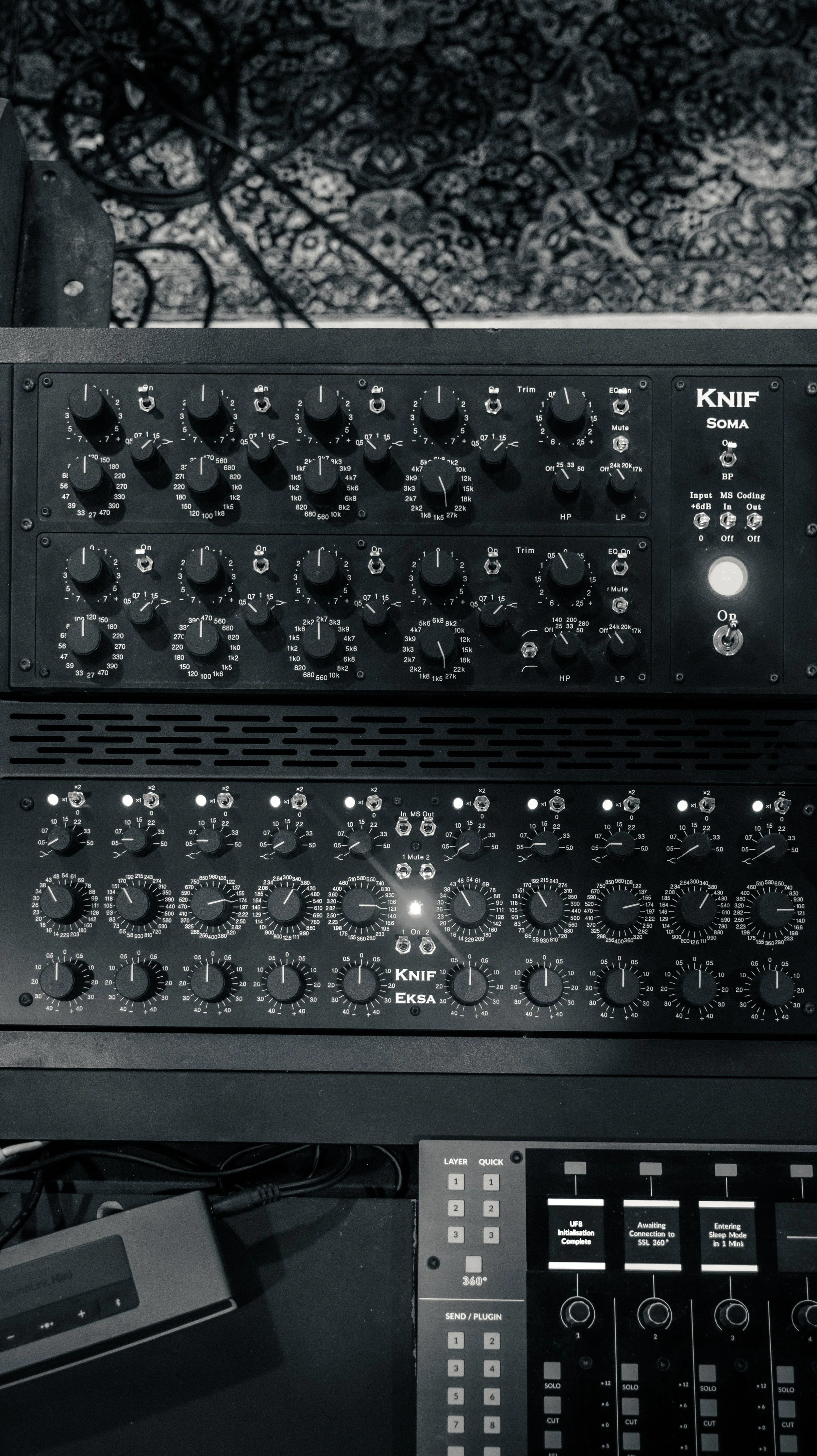
Body of Sound. Jonte Knif’s Soma and Eksa, the principal EQ suite on my desk. Soma for beautification, Eksa for precision.
Readers of my Vari Mu II discussion will already be familiar with my mild obsession with Knif Audio and with Jonte Knif, who has been designing and hand-building audio equipment in Helsinki since 2005. I briefly mentioned two of his designs, Soma and Eksa, as two of the most transparent, accurate, and musical equalizers ever conceived. Soma, Jonte says, is designed with careful consideration for "the beauty of sound." I can confirm that this is not marketing language.
Etymological note: "soma" in Finnish can mean something like "pretty". In Ancient Greek "soma" means "body". In Vedic Sanskrit, "soma" can refer to a psychedelic cocktail made from psychoactive botanicals.
Soma is a dual-channel passive tube equalizer intended for mastering. That description suggests it ought to be categorized alongside the Manley Massive Passive or a pair of switched Pultecs. If that were the entire story, Soma would still be a very fine equalizer.
However, Soma gracefully departs from the passive EQ tradition in one respect: it is the only commercially available passive EQ with real bandwidth adjustment. On a conventional passive equalizer, changing the bandwidth parameter will also alter the amount of boost or cut being applied, shifting the resulting curve in ways one must anticipate and compensate for. Engineers have accepted this compromise for decades. Jonte did not. On Soma, when one adjusts bandwidth, that is the only parameter that changes, allowing one to dial in gain at a specific frequency and then widen or narrow the curve without disturbing the amplitude.
The engineering that makes real Q adjustment possible? Jonte and his gnomes wind the inductors with as many taps as required to switch between inductance and capacitance combinations that change bandwidth without altering gain. Fewer taps would mean coarser steps, or the kind of Q-gain interaction for which every other passive EQ settles. In practice, this yields much finer control over the transfer curve than any other passive topology. One can sweep with the narrowest Q to quickly find the right spectral region and then widen the curve — the same methodology one would use on any parametric.
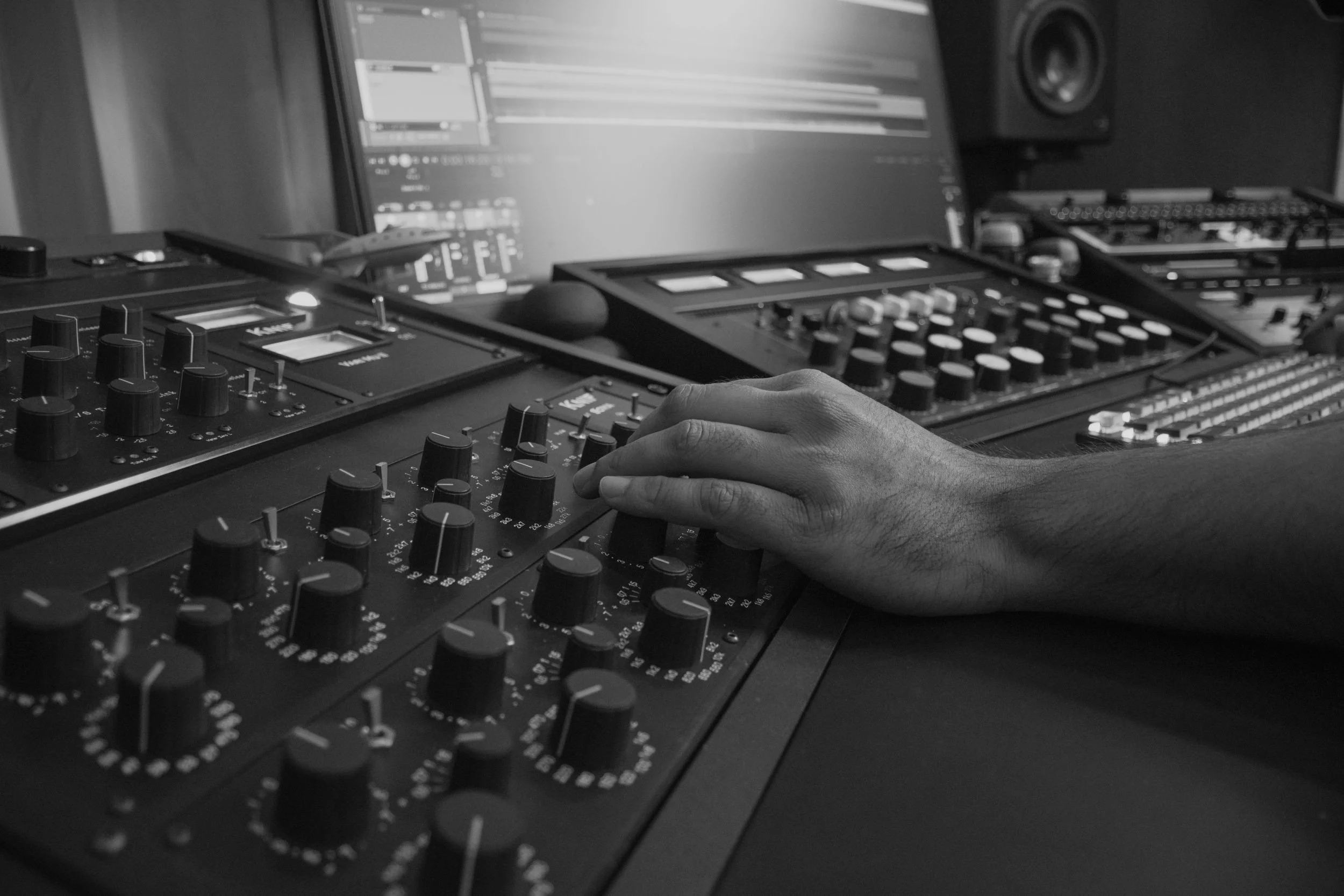
Total Luxury. Elma switches settle rather than snap into position, a difference one feels long before the record is finished.
The makeup gain amplifier is a two-stage tube affair paired with Lundahl amorphous core output transformers. Together, they introduce a controlled, subtle beautification of the signal. Pushed hard, Soma saturates without sounding harsh, gritty, or conversely flabby or farty. It's simply a smooth sausaging of the input signal’s waveform.
On the faceplate, one will find what appears to be a small city of Elma rotary switches. All of them are fitted with soft touch collet knobs that propel the unit squarely into luxury territory. Every setting is stepped, so every setting is recallable. I can't overstate the value of switches over continuously variable potentiometers in a mastering context: printing alternate masters for a twelve-song LP with different settings on every track means twelve unique recalls. Using switched controls, each recall for the alternate masters lands exactly where it did for the main masters.
Soma offers four bands of parametric equalization with interleaved frequency ranges from 27 Hz all the way up to 27 kHz. Each band can operate as a bell with four Q settings (0.5, 0.7, 1.0, 1.5) or be switched to a shelf, and each has its own bypass. Boost and cut range is ±8 dB across all bands. Trim controls, high-pass, and low-pass filters round out each channel's controls.
Soma's M/S encoding and decoding is performed entirely by multiple windings on the input and output transformers, switched locally with relays. This means engaging the M/S matrix does not add any components to the signal path. On other units, mid/side processing often introduces components the signal must pass through, but Soma's implementation is as sonically invisible as materials science allows. The unit can also function independently as an M/S encoder or decoder for subsequent stereo units in the analog chain. In M/S mode, the side channel's high-pass filter can be switched to a gentler slope with significantly higher frequency selections. This is elliptic filtering: it narrows the stereo image in the low frequencies, concentrating bass energy toward the center. Vinyl mastering folks may appreciate this, but its utility extends beyond the lathe, allowing one to centerize bass or de-mud the side channel in a variety of circumstances.
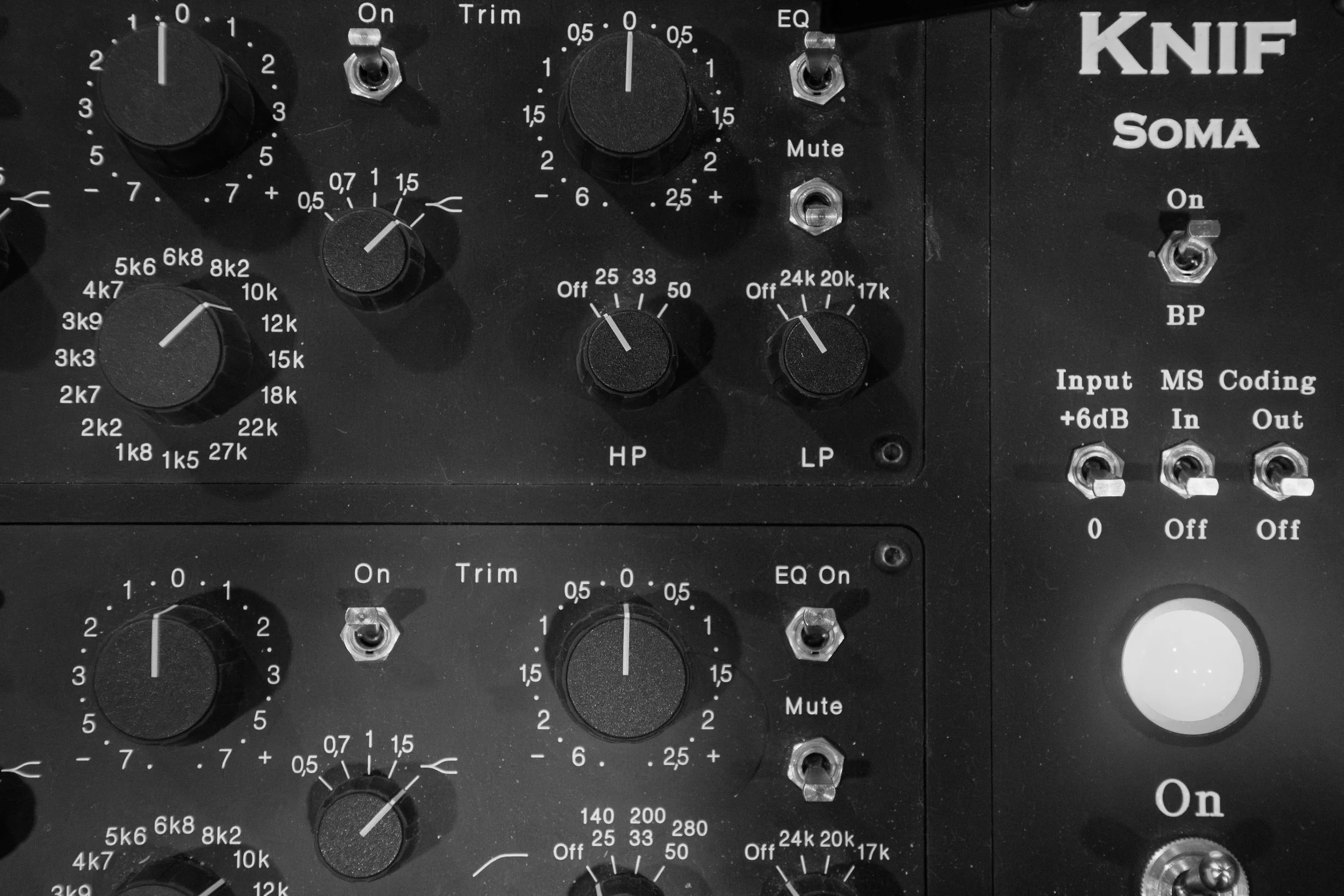
Thoughtful Asymmetry. The channel trim control runs from 0 to +2.75 dB in 0.25 dB increments on the boost side, but extends just past -6 dB on the cut side.
Soma can do things others struggle to deliver. One can go further with boosts in the bass or treble regions that typically get boomy or harsh, respectively. Similarly, one can cut deeper than caution usually permits where there is especially loud bass, midrange, or treble information without losing the essence of the program material. Soma does not paint with color the same way a Pultec does, where a single dB arrives like cadmium orange poured across the canvas. The color has to come from the moves one makes. But because the box adds none of its own, those moves can be far bolder than one would dare elsewhere, and what comes back is the program material and one’s interpretation of it — however restrained or colorful that interpretation may be. Soma keeps one listening to the song, not Soma.
The most common way I employ Soma is by keeping all EQ parameters at unity, save for filters, while feeding the unit the right amount of gain to get that subtle beautification it so easily provides. When I do reach for the bands, it’s usually ±0.5 dB with a single low or high shelf, or a single bell in the mids. Shaping bass is easy with Soma, but I tend to prefer Eksa or a digital EQ for the lowest octaves.
Of course, this means that the engineering that makes Soma unique hardly matters at my desk. What does matter is that it sounds good when driven, that the filters are good, and that giving it enough level to do its thing is all it takes.
So, depending on how one engages with Soma, more than one translation of its name fits. Run flat and driven, as I run it, the Finnish is befitting. The transformers make things pretty and little else happens. Used to “paint with color,” the Greek fits better, as one sculpts the body of the music.
Knifaudio.com
P.S. Plugin Alliance has released a software version of Soma in collaboration with Brainworx. It is a usable digital interpretation that I own, but admittedly rarely use in place of the real deal. The interplay between Eksa, Soma, and Vari Mu II is what makes Soma so special to me.