
Let's Discuss the Knif Soma Mastering Equalizer
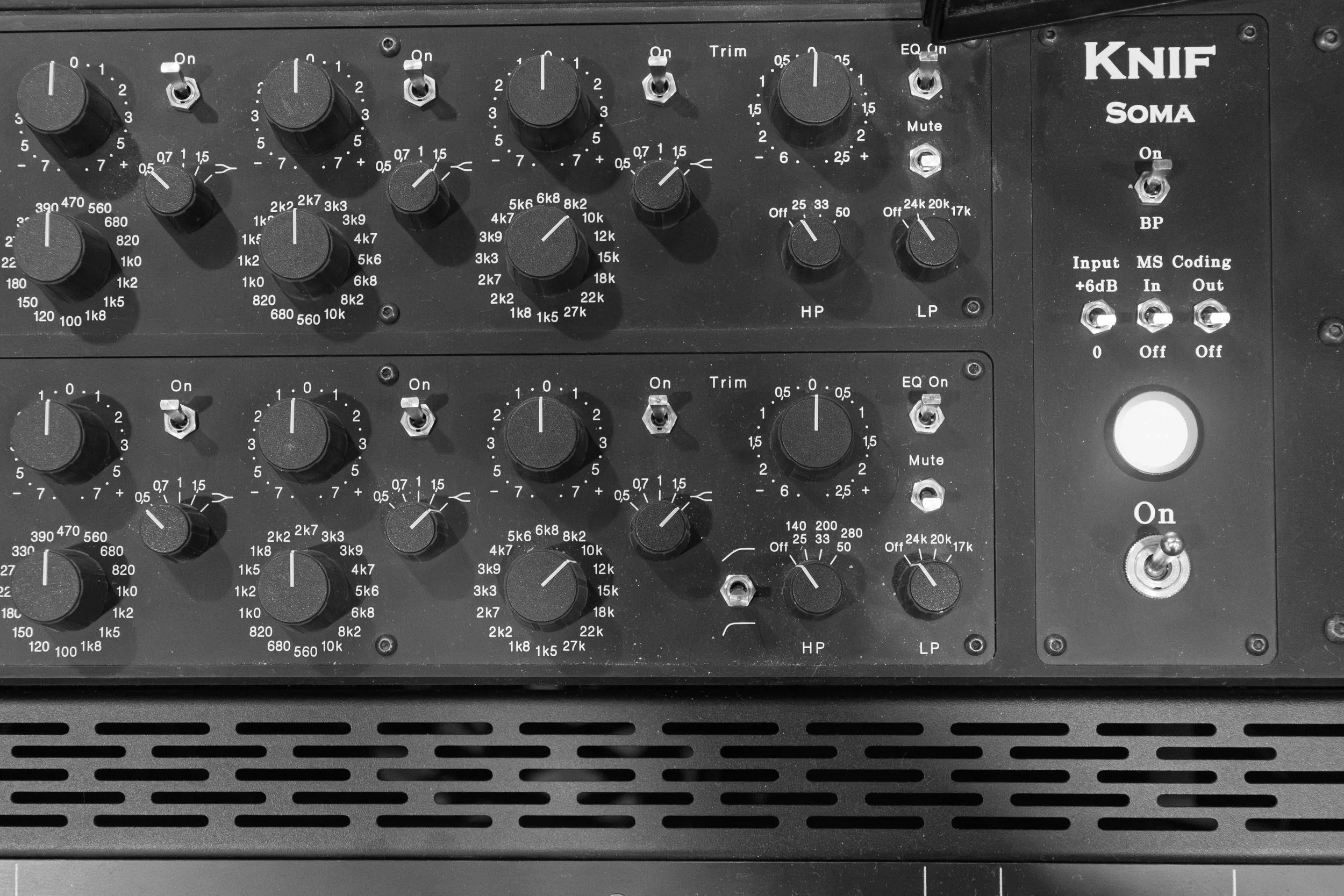
Body of Sound. Four rack units of Finnish passive equalization housing ~150 gold-plated subminiature relays and a pair of hand-wound mu-metal shielded inductors in each band.
Readers of our Vari Mu II discussion will already be familiar with Knif Audio and with Jonte Knif, who has been designing and hand-building audio equipment in Helsinki since 2005. In that article, we briefly mentioned Soma and Eksa as two of the most transparent, accurate, and musical equalizers ever conceived. The Soma, Jonte says, is designed with careful consideration for "the beauty of sound." Having now lived with the unit for quite some time, I can confirm that this is not marketing language.
Soma is a dual-channel passive tube equalizer intended for mastering (and mixing) applications. That description places it alongside units like a pair of switched Pultecs and the Manley Massive Passive. If that were the whole story, it would still be a very fine equalizer. But Soma departs from the passive EQ tradition in a critical way: it is the only commercially available passive EQ with real Q adjustment. One might wonder what "real" Q adjustment means in this context. On a conventional passive equalizer, changing the bandwidth will inadvertently alter the amount of boost or cut being applied, leading to unexpected changes in the EQ curve. Engineers have accepted this compromise for decades. Jonte did not. On Soma, when one adjusts bandwidth, that is the only parameter that changes. In practice, this means that one can dial in a specific amount of gain or attenuation at a specific frequency and subsequently adjust how much the umbrella of adjustment covers.
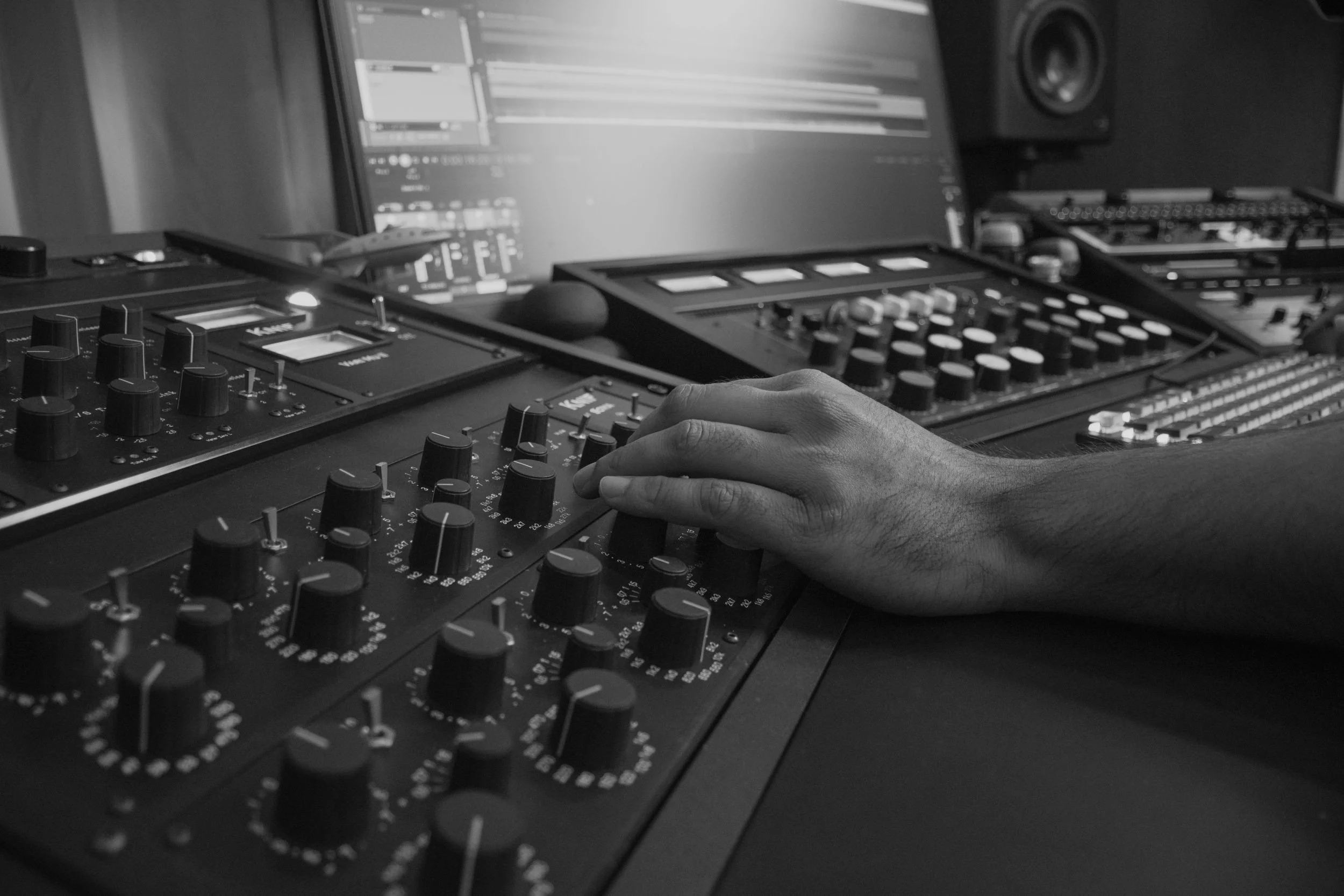
The Philosopher’s Relays. The implementation of real Q adjustment and frequency selection is established by switching capacitor and inductor values via gold-plated subminiature relays. About 150 of them. The switching is controlled by elementary CMOS logic circuits instead of a microcontroller, a deliberate choice that prioritizes longevity and ease of maintenance. Those relays are rated for 100 million operations, and Jonte notes that it is likely "not a single one will ever break." Whether or not that claim survives the heat death of the universe, the intent is clear: this is yet another piece of Knif gear built for permanence that must be considered as part of one’s estate.
The mu-metal shielded inductors are wound in-house by Jonte himself, with the maximum number of taps required to make the Q adjustment possible. More taps means more selectable inductance values, which is what makes the independent Q adjustment possible. The circuit must switch between enough inductor (and capacitor) combinations to change bandwidth without altering the gain. Fewer taps would mean fewer options, coarser steps, or the kind of Q-gain interaction for which every other passive EQ must settle. This is the mechanical reason Soma can do what no other passive EQ does.
All capacitors in the filter section are polypropylene (according to Jonte, only in the lowest frequency range was it necessary to use some polyester ones). The make-up gain amplifier is a simple two-stage vacuum tube affair with “a moderate amount of DC-coupled feedback”, paired with Lundahl amorphous core output transformers. Together, they introduce what Jonte describes as a controlled, subtle beautification of the signal. It is the Soma equivalent of the Vari Mu II's subtle enhancing drive; present when desired, totally invisible when not. The "saturation" afforded by Soma is not harsh, gritty, or conversely flabby or farty. It's a smooth, sausaging of the input signal. Thus, in my studio it is often tempting to feed this unit way too much input signal in conjunction with the +6 switch to take advantage of the "free lunch" that is offered in the form of simultaneous amplification and gain reduction that comes from an induction equalizer such as Soma.
Upon racking the unit, which like the Vari Mu II is 4 units tall and carries some weight, one is again reminded of the care that Jonte gives to the structure surrounding his electronics. The metalwork is truly impeccable. If the Vari Mu II could survive re-entry into Earth's atmosphere, Soma could likely do so while maintaining perfect recall.
On the faceplate, one will find what appears to be a small city of Elma rotary switches. There are 23-position switches for boost/cut and gain trim, 16-position switches for frequency selection, and 5-position switches for the shelf/Q adjustment. All of the Elma switches are fitted with soft touch collet knobs — a small detail that anyone who spends six to eight hours a day turning controls will appreciate. And every setting is stepped… so every setting is recallable. I cannot overstate the value of relay switches over continuously variable potentiometers in a mastering context.
The equalizer offers four bands of parametric equalization with interleaved frequency ranges: the first band covers 27 to 470 Hz, the second spans 100 Hz to 1.8 kHz, the third reaches from 560 Hz to 10 kHz, and the fourth extends from 1.5 kHz all the way up to 27 kHz. Each band can operate as a bell or be switched to a shelf, and each has its own bypass. Boost and cut range is ±8 dB across all bands. In addition to the parametric bands, the unit includes 12 dB/octave high-pass and low-pass filters. The high-pass offers selections at 25, 33, and 50 Hz, while the low-pass provides options at 24, 20, and 17 kHz.
Soma is equipped with a transformer-based passive mid/side matrix, and this is where things get especially interesting. The M/S encoding and decoding is performed entirely by multiple windings on the input and output transformers, switched locally with relays. This means that engaging the M/S matrix does not add any components to the signal path. Mid/side processing often introduces compromises — or at minimum, a few extra op-amps. Soma's implementation is as sonically invisible as materials science allows. This also means that the unit can function independently as an M/S encoder or decoder for subsequent stereo equipment in the analog chain, much like the Vari Mu II's independent M/S switching.
In M/S mode, the right channel's (now the Side channel's) high-pass filter can be switched to a 6 dB/octave slope with significantly higher frequency selections — 140, 200, and 280 Hz — enabling elliptical bass equalization. This effectively narrows the stereo image in the low frequencies, concentrating bass energy toward the center. Vinyl mastering engineers will immediately appreciate this function, but its utility extends well beyond the lathe.
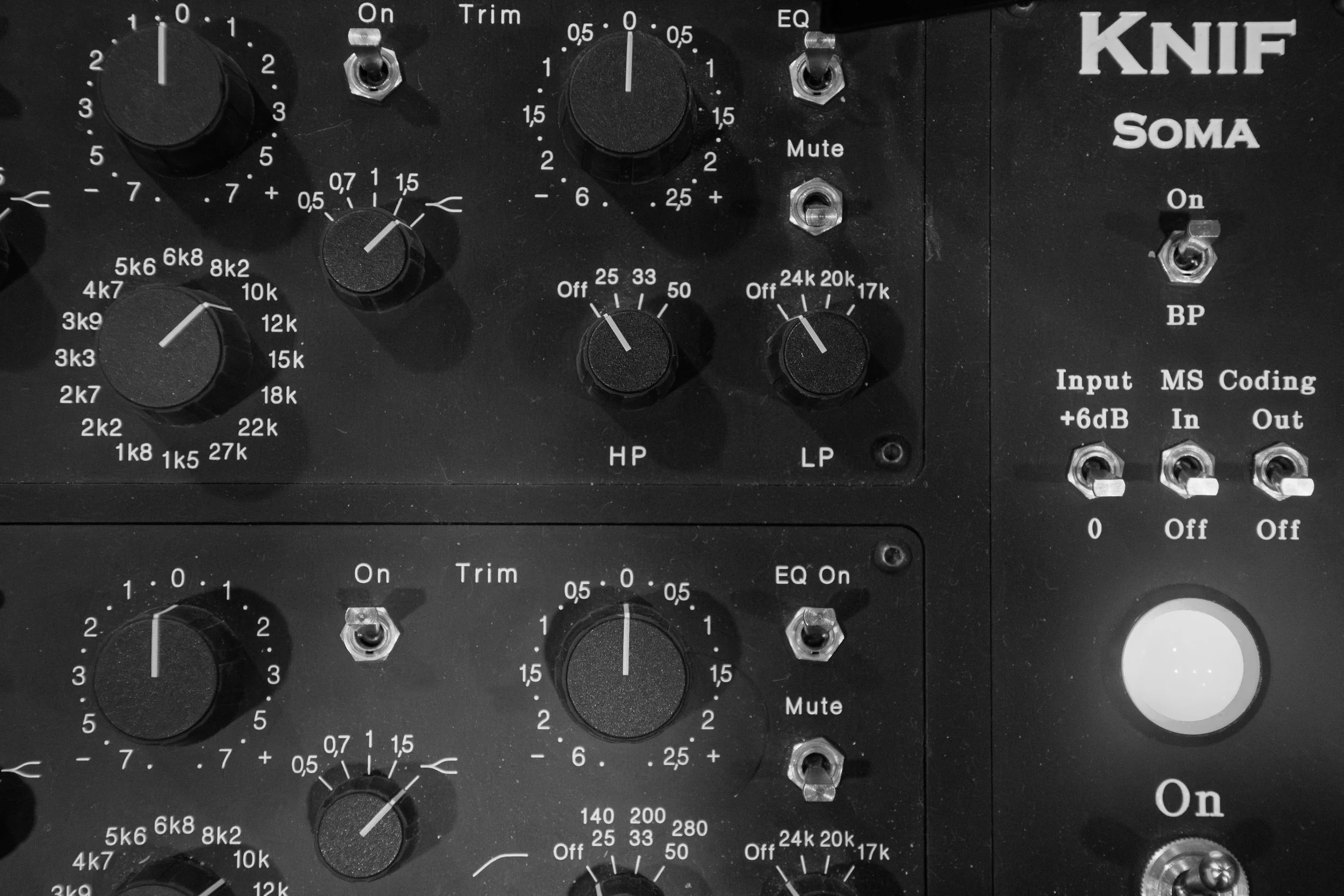
Thoughtful Asymmetry. The channel trim control deserves mention: it runs from 0 to +2.75 dB in 0.25 dB increments on the boost side, but extends all the way to -6 dB on the cut side. This accommodates the level drop that occurs during M/S encoding, allowing the unit to be used in stereo while encoding to M/S at the output without running into gain staging headaches. A +6 dB mode is also available, boosting the internal signal level for more obvious coloration and character. This is Soma's equivalent of driving the Vari Mu II. It is an invitation, not an imposition!
Every time I engage Soma, I find myself working in the same solution-oriented, purpose-driven fashion that the Vari Mu II encourages. Some tracks receive broad tonal corrections at half a dB, the kind of moves that are immediately felt but nearly impossible to identify by ear alone. Other tracks receive more aggressive treatment with the +6 dB switch engaged, inviting the tubes and transformers to contribute welcome warmth and saturation. And very frequently, the mid/side matrix is the most useful feature on the entire faceplate, allowing me to bring up a vocal or enhance a bass line. Oftentimes I will mute the side channel and dial in the center channel EQ in isolation, a process that typically yields excellent results in translation. Soma keeps me listening to the song, not Soma. And just like the Vari Mu II, it is remarkably difficult to make it sound bad.
Knifaudio.com
P.S. Plugin Alliance has released a plugin version of the Soma in collaboration with Brainworx. It is a usable digital interpretation that I own, but admittedly rarely use. The hardware is the hardware. Notable users of Soma include, unsurprisingly, Mike Kalajian of Rogue Planet Mastering, Brock McFarlane of CPS Mastering, John Greenham of Clearlight Mastering, and many many others.